Quantum Technologies and Cybersecurity: Insights from TD Cowen Research Themes 2026
Understanding the Intersection of Quantum Computing, AI, and the Future of Cyber Defense

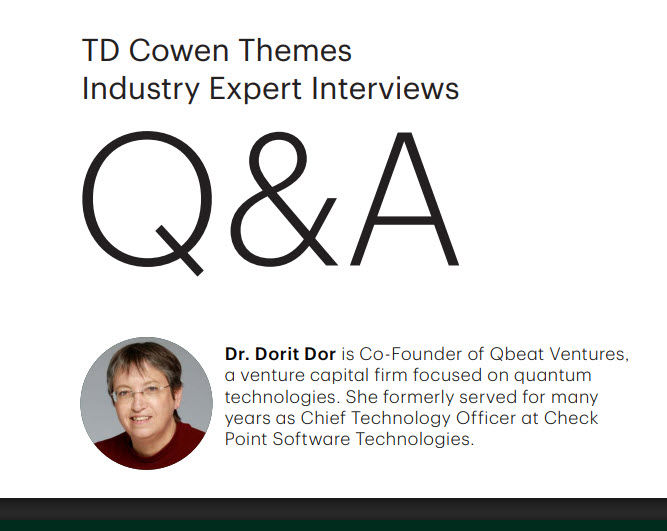
Qbeat Ventures Co-Founder Dr. Dorit Dor was selected as an industry expert for TD Cowen's Research Themes 2026 report, contributing insights on quantum technologies and their implications for cybersecurity. Her participation in this influential publication reflects both the growing significance of quantum computing in the investment landscape and the deep expertise Qbeat brings to this transformative sector.
Quantum Technologies: A New Computation Paradigm
Quantum computing represents an entirely different approach to computation, fundamentally distinct from both serial and parallel computing paradigms. Operating on the principle of superposition, where qubits exist in undetermined states, quantum computers can calculate all possibilities simultaneously. This isn't simply faster computation, it's an exponential leap that will enable solving problems once considered intractable.
The technology's potential spans multiple domains: physical simulations in materials science and drug discovery, complex optimization challenges in logistics, and applications in energy and finance. Over the next two years, we expect to see tangible breakthroughs where quantum systems start delivering real solutions to previously unsolvable problems.
Core Categories of Quantum Innovation
Quantum Computing: The baseline technology that introduces a completely new computation paradigm, leveraging superposition to achieve exponential speed in solving specific types of problems.
Quantum Sensing: Leveraging the extreme sensitivity of particles in superposition, quantum sensors can detect minute changes with unprecedented accuracy. For context, while a regular thermometer might measure temperature within one decimal place, a quantum thermometer could sense a change so small that it could recognize the heat from a single candle a mile away.
Quantum Communications: Using entangled particles to carry data in quantum states that cannot be hacked or intercepted, offering fundamentally secure communication channels.
Post-Quantum Cryptography (PQC): Solutions designed to protect against the threats quantum computing poses to current encryption methods.
The Cybersecurity Challenge
Perhaps the most pressing implication of advancing quantum capabilities concerns cybersecurity. Quantum computing will eventually undermine core assumptions of modern cryptography, specifically, that certain mathematical problems are practically impossible to solve.
For over three decades, experts have known that sufficiently powerful quantum computers could break today's standard encryption keys, which currently safeguard everything from financial transactions to national security data. While no existing quantum computer yet possesses this capability, and development may take five years or more, the inevitability of this breakthrough has driven intense research and nation-state efforts to accelerate quantum capabilities.
Forward-looking organizations, especially banks, critical infrastructure operators, and large enterprises, are already taking action. Transitioning to post-quantum encryption will require years of comprehensive auditing and updating of every system and protocol where encryption occurs. There's also urgency around mitigating the "harvest-now, decrypt-later" threat, whereby attackers capture encrypted data today with the intention of decrypting it once quantum computers reach sufficient power.
Two Paths to Quantum-Resistant Security
Organizations are pursuing two primary approaches:
Hardware-based quantum networking solutions that use quantum principles themselves - particle entanglements rather than mathematical complexity - to protect data. These solutions are expensive and appropriate for large institutions exchanging information with one another, but not practical for everyday use.
Post-Quantum Cryptography (PQC): Building quantum-type agility into software, updating it with secure protocols not yet known to be solved by quantum computing, and importantly, maintaining readiness for future updates. This represents an ongoing evolution, essentially "a forever chase."
Quantum Sensing: First to Market
Of all quantum technologies, quantum sensing is the furthest along in demonstrating real-world capabilities. It's already beginning to replace traditional modalities in applications such as detecting abnormal cellular activity in MRIs or identifying nearly invisible defects in materials in industrial contexts. The level of accuracy and consistency differs dramatically from what is widely used today.

The Complementary Relationship Between AI and Quantum
AI and quantum computing serve different but complementary roles in solving complex problems. AI excels when dealing with problems involving high volumes of continuous data. Quantum computing, in contrast, is designed for problems whose complexity resides in having only small or partial amounts of available data.
The analogy: classical computing, even with AI, would need to check each individual straw of hay to find a needle, checking roughly half the straws on average. A quantum computer can instead touch roughly one out of every thousand straws.
These technologies work together synergistically. Quantum computing can solve very different kinds of problems on the front end, generating over time the kind of continuous data volume that AI is well suited to process. Because quantum itself maintains physical behavior, it has a unique ability to engage with problems in the physical world.
Current State: Early But Accelerating
Quantum computers exist today, and approximately 100 enterprises already have quantum groups working within them. These aren't organizations that develop quantum technologies per se, they're industries such as pharmaceuticals, logistics, materials, and finance. These companies are using quantum computers to solve problems important to their operations.
However, current quantum computers remain limited. Everything accomplished on them so far could still be simulated on classical computers. The industry needs more qubits to reach the point where results represent unique achievements that cannot be yielded using classical computing.
But this inflection point is approaching. There's little question that this technology will scale, it's simply a matter of time. Solving complex problems of cryptography will require thousands of qubits and likely remains years away, but many problems can be solved earlier. Fairly soon, the industry will reach the point where quantum solutions surpass what can be replicated with any classical technology.
A Portfolio Approach to Quantum Investment
Many different developments are progressing in parallel across quantum technologies. This won't be a winner-takes-all outcome. The field is not yet near a consolidation phase, which means organizations and investors need to take a portfolio approach to derive maximal value from the many developments and approaches currently underway.
Opportunities Outweigh Threats
While quantum computing and technologies aim to solve the unsolvable, which inevitably presents new challenges, the opportunities far exceed the risks. Quantum computing is about much more than breaking codes. The opportunity lies in solving very big problems, and while this will undoubtedly present new challenges, the potential applications are transformative.
There is always tension around profound technological innovation, and quantum technologies will be no different. However, the capabilities these technologies will unlock—from revolutionizing drug discovery to optimizing global supply chains to fundamentally securing communications—represent generational opportunities for those positioned to capitalize on them.
Read the Full Report
For comprehensive analysis of quantum technologies alongside other critical themes shaping the global economy, including artificial intelligence, the future of warfare, demographic catalysts, and digital assets - read the complete TD Cowen Research Themes 2026 report at: https://go.marketing.tdsecurities.com/TDC-Market-Themes-2026
About TD Cowen Research Themes 2026
TD Cowen's annual Research Themes report features award-winning analysts in conversation with over 20 of the world's leading experts on secular trends shaping global economic discourse. The 2026 edition covers topics including China's evolving position, the future of warfare, artificial intelligence, quantum technologies, health care innovation, and the future of the U.S. dollar.


